


Albert Heijn and True Price are joining forces. From 18 April 2023, Albert Heijn started true pricing experiments in three AH to-go locations: in Zaandam, Wageningen and Groningen. Customers were able to see the real price and voluntarily pay for various coffee products, such as cappuccino, latte and espresso. With this experiment, Albert Heijn and True Price wanted to raise awareness of social and environmental costs, help people make more sustainable choices and find out what customers think. In the course of 2023, they aimed to expand the experiments to multiple locations and broaden them to include more products.
For this pilot, True Price calculated the real price for three products: coffee (from Brazil and Ethiopia), long-life whole milk and oat milk (Barista edition). The real prices were not only shown to consumers, they were also able to pay them voluntarily. The extra payment made by consumers was donated to the Rainforest Alliance, which used it to develop projects to remedy the external costs in Albert Heijn’s coffee chains as much as possible. In this way, we gave consumers the opportunity to contribute directly to more sustainable coffee, without excluding people who are unable or unwilling to do so.

About the project
The project involved calculating the real price gap for three products (see below). We mapped out as much of the product chain as possible. The calculated real price gap covers nine impacts, mainly during the cultivation and production phase of the products (see below). Some impacts (such as soil pollution) and parts of the chain (such as packaging) have not been included in the calculation due to a lack of reliable data. The results for the three products (in £/kg) were converted to the coffee products in AH to-go’s.
The results provide a robust estimate of the external costs for average products. These are only partially applicable to the plantations where Albert Heijn purchases its coffee (the RFA certification, for example, is only partially included here). The calculations are based on a mix of data provided by Albert Heijn, supplemented with secondary data collected by True Price. The real price gaps are calculated using the True Price method, which offers a scientific, well-developed and widely supported method for calculating real prices.

Products
Coffee
AH Perla private label – Arabica • Brazil (85%) & Ethiopia (15%)
Ling-life milk
Oat milk
Oat milk, barista edition • Oats mainly come from Finland
Approach
How did we estimate the true price gaps?

Value Chain Steps
The estimates cover material parts of the value chain per stage
- Raw materials
- Cultivation
- Processing
- Transport
- Shop

Impacts
The estimates cover material parts of the value chain per stage
- Contribution to climate change
- Land use
- Use of scarce water
- Air pollution
- Depletion of fossil fuels
- Water pollution
- Child labour
- Underpayment of employees
- Under-earning of small farmers

Data
The estimates cover material parts of the value chain per stage
- Primary data on coffee by Albert Heijn
- Secondary data collected by True Price
- True Price monetization factors
The Results
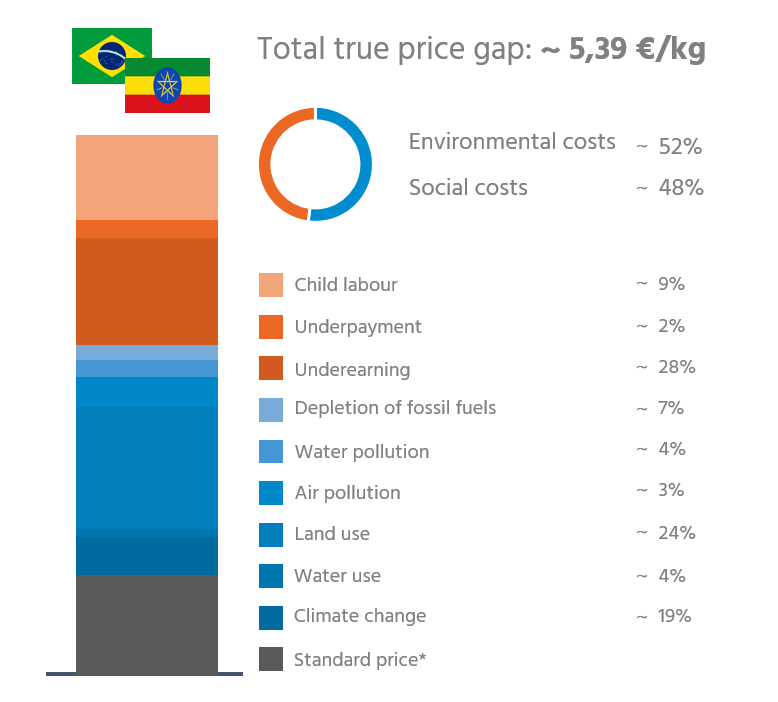
1- Coffee (85% from Brazil and 15% from Ethiopia)
Observations:
- The estimated social and environmental costs are almost equal.
- The greatest environmental impact is land use (~28% of the total impact). This reflects the costs of biodiversity loss resulting from the conversion of original natural habitats (such as forests, grasslands, or rainforests) into agricultural land. Albert Heijn purchases Rainforest Alliance certified coffee, which guarantees that no deforestation has taken place since 1 January 2014. The True Price methodology takes a longer analysis period into account. Air pollution and climate change are also significant consequences.
- The social impact is mainly caused by the social costs of Ethiopian coffee, which can have a high impact on underemployment and child labour.
- Most of the impact (94%) occurs on the coffee plantations. Processing (3%), shipping (2%) and transport (1%) account for a small part of the total impact.
2- A comparison between the two origins
Observations:
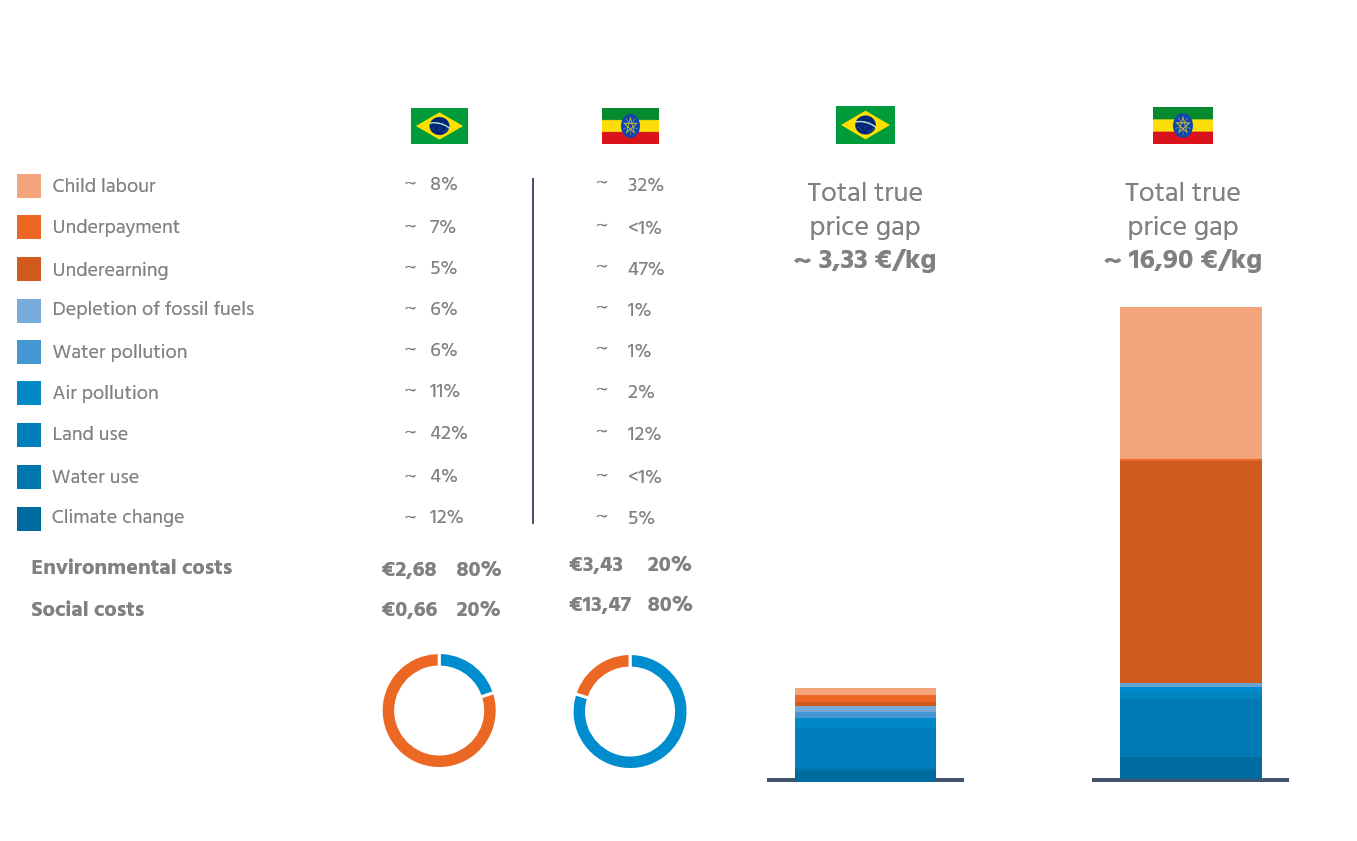
- The estimated social and environmental costs are almost equal.
- The greatest environmental impact is land use (~28% of the total impact). This reflects the costs of biodiversity loss resulting from the conversion of original natural habitats (such as forests, grasslands, or rainforests) into agricultural land. Albert Heijn purchases Rainforest Alliance certified coffee, which guarantees that no deforestation has taken place since 1 January 2014. The True Price methodology takes a longer analysis period into account. Air pollution and climate change are also significant consequences.
- The social impact is mainly caused by the social costs of Ethiopian coffee, which can have a high impact on underemployment and child labour.
- Most of the impact (94%) occurs on the coffee plantations. Processing (3%), shipping (2%) and transport (1%) account for a small part of the total impact.
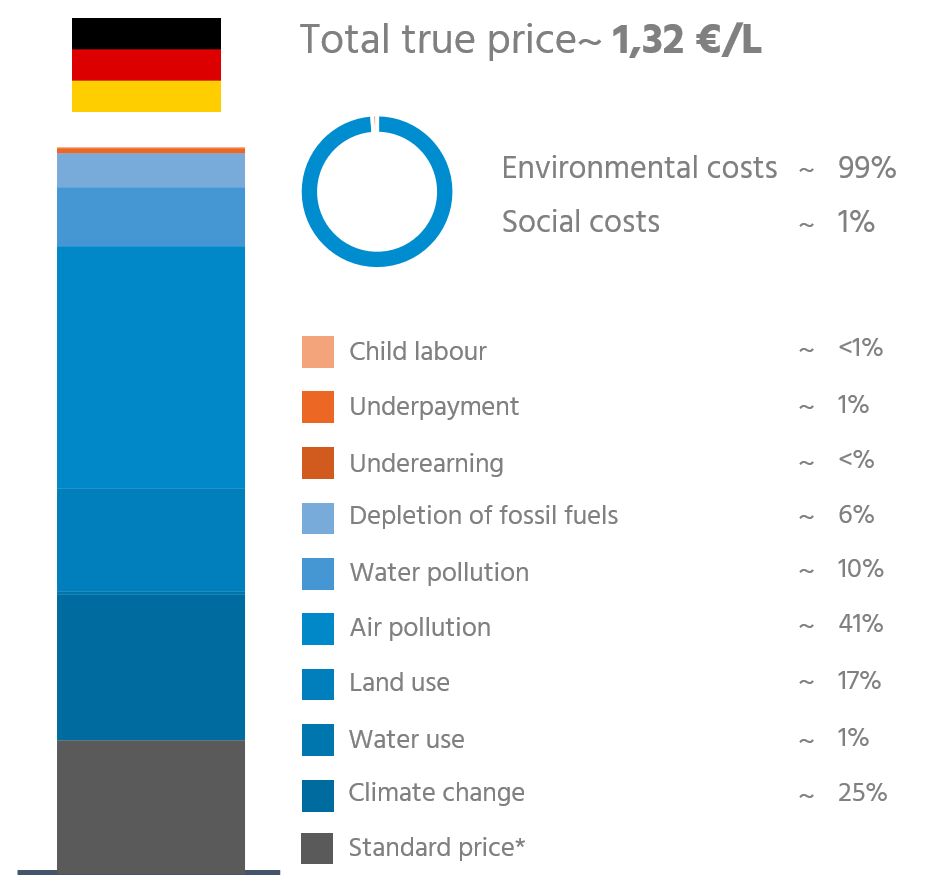
3- Cow milk (from Germany)
Observations
- Almost the entire real price gap (>99%) consists of environmental costs.
- Air pollution has the greatest impact, accounting for 41% of the total. This is due to both the footprint of emissions and the high costs of air pollution as a result of damage to nature and its effect on human health.
- The results also include the production of animal feed. For example, protein-rich feed (including soy-based feed) produced in South America.
- Most of the impact (91%) occurs on the farm (including animal feed) during the production of raw milk. Processing (7%) and transport (2%) account for a small part of the total impact. Only the effects related to energy consumption (climate change, air pollution and depletion of fossil fuels) have been included in these chain steps.
- The social effects are low, in line with expectations.
4- Oat milk (with oats from Finland)
Observations
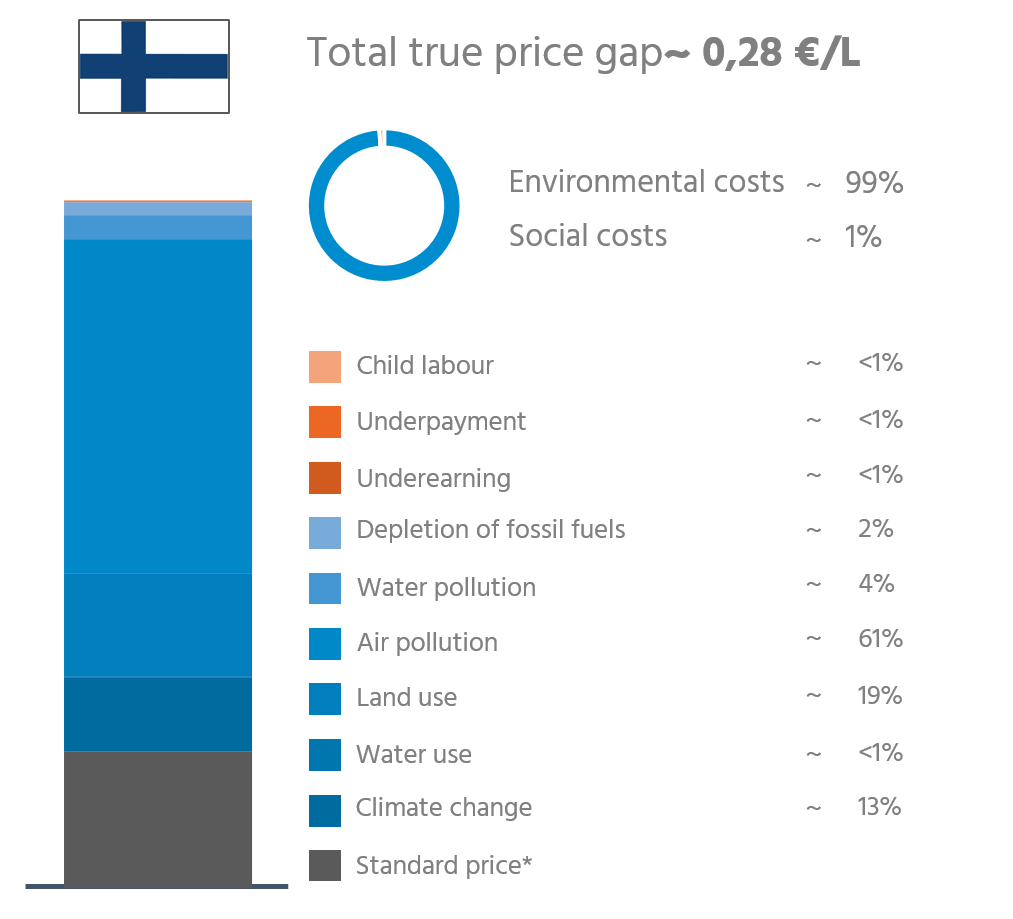
- The real price gap for oat milk is only 21% of that for cow’s milk.
- Almost the entire real price gap (>99%) consists of environmental costs.
- Air pollution has the greatest impact, accounting for 61% of the total. This is mainly due to the production and application of artificial fertilisers and the use of machinery (based on fossil fuels) during the cultivation of oats.
- Most of the impact (85%) occurs on the farm during oat cultivation. During the cultivation phase, the greatest impact is air pollution (see previous page for explanation and drivers).
- Processing (4%) and transport (11%) account for a smaller part of the total impact. Climate change as a result of greenhouse gas emissions is the most significant impact here. Only the effects related to energy consumption (climate change, air pollution and depletion of fossil fuels) have been included in these chain steps.
- As expected, the social impacts are low.
Good to know…
The assessment process in this project includes the process, scoping, modelling, data and reporting steps of a true price calculation, according to the True Price Assessment Method. One general validation round on the process and model was carried out by a team member not involved in the project.
All validation comments, questions and remarks were noted. They were processed by the project team. The processing was checked by the validators. All steps, choices and assumptions were discussed and agreed upon by the partners.
Limitations of the results
The figures in this analysis are estimates of the actual price of the products. These estimates contain uncertainty, because models and secondary data are used in several places. In a number of cases, the uncertainty is substantial, as this project is a pilot and the companies in the chain do not yet collect much actual price data. For this reason, caution and restraint are required when using and interpreting the results. We advise everyone to read the results, approach, assumptions and limitations carefully to avoid misunderstandings and incorrect conclusions.