


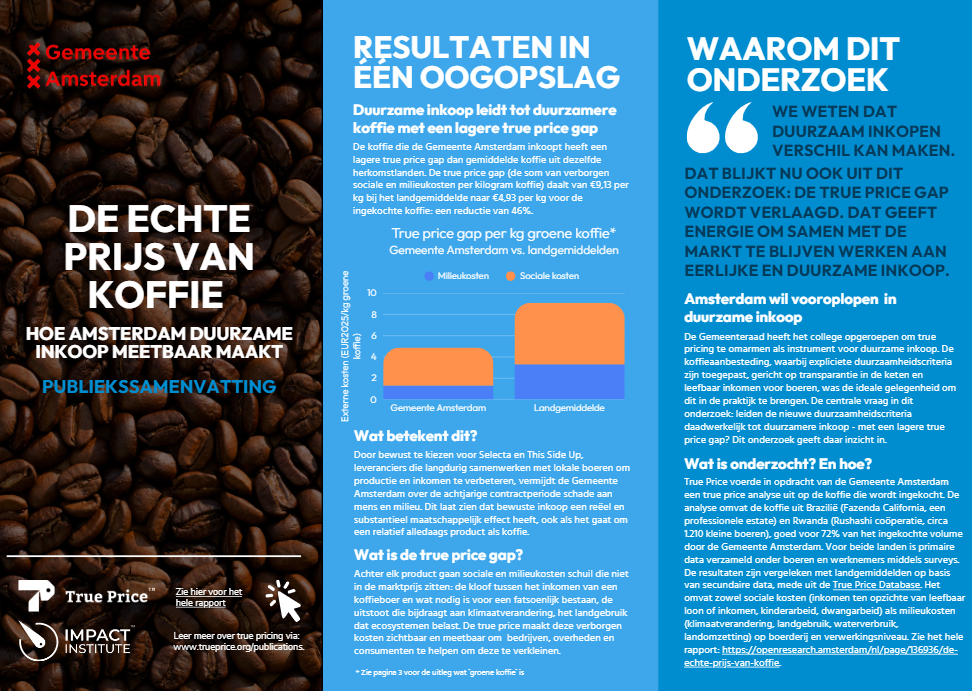
Do sustainability criteria in a tender actually work? The City of Amsterdam wanted to know for sure, and had the coffee it has bought since its new tender assessed. The answer: 46% lower hidden costs to people and planet than average coffee from the same countries. Over the eight-year contract, that adds up to more than €4.1 million in avoided damage. Sustainable procurement isn’t expensive. It creates value.
Public procurement: an underrated lever
Governments are big buyers. In 2019, Dutch public authorities together already purchased €85 billion in goods and services, around 12% of all purchasing in the Netherlands. Across Europe, public procurement accounts for about 15% of GDP. Spent deliberately, that money can move markets.
Yet in practice, the lowest price often wins. Sustainability requirements feel like an extra cost, and their effect usually stays invisible. That keeps a stubborn idea alive: that sustainability is expensive, and that exhausting the planet and squeezing people is somehow efficient. But cheap often turns out to be expensive. The bill simply lands somewhere else: with farmers, with the climate, or with future generations.
What is changing in Europe
Right now, that thinking is being challenged at European level. On 9 September 2026, the European Commission presented its proposal for a Public Procurement Act. It would replace the three current procurement directives with a single regulation that applies directly in all member states. The key shifts:
- Best price-quality ratio as the default. Not the lowest price, but the best value becomes the starting point for awarding contracts.
- Sustainability more firmly embedded. The Commission would be empowered to set mandatory environmental requirements in certain cases.
- Food as a priority. The proposal names food as a priority sector: relevant to everything governments buy for canteens, schools and care institutions.
The proposal still has to pass the European Parliament and the Council, so it may change
What Amsterdam did
Amsterdam was ahead of the curve. The city council called on the municipal executive to embrace true pricing as a tool for sustainable procurement. About two years ago, a group of pioneers within the municipality managed to include strong sustainability requirements in the coffee tender, for some 20,000 employees. The requirements covered supply chain transparency, a living income for farmers and child labour. Selecta and importer This Side Up won the contract.
The municipality then asked True Price and Impact Institute to measure what that choice had delivered.
What it delivered
The true price gap, the hidden social and environmental costs per kilo, falls from €9.13 for average coffee to €4.93 for the municipality’s coffee. That saves around €514,000 a year. As more than a quarter of the coffee has not yet been included, this is a lower bound. And because the result is expressed in euros, it becomes tangible: it’s not just about less CO₂, but about costs society avoids.
The study also shows where procurement reaches its limits. Farmers in Rwanda own just 0.09 hectares of land on average, which makes a living income hard to reach even with a good price. That insight is exactly what helps the municipality and its suppliers take targeted next steps.
What you can do
As a buyer
- Start with the risks. Before the tender, map where the largest social and environmental risks sit in the supply chain, and build your criteria around them.
- Make criteria measurable. Use clear definitions, such as living income and child labour, so you compare bidders fairly.
- Ask for an improvement plan. Assess not only current performance, but also how a supplier plans to reduce its largest impacts. Keep data requirements realistic so smaller suppliers have a fair chance.
- Measure during the contract. Use true pricing at evaluation or renewal to make progress visible.
As a policymaker or council member
- Make an explicit choice about the type of supply chain partner. Professional estates offer more measurable certainty; working with smallholders has more potential to reduce poverty. Be clear about which ambition comes first.
- Embed it in policy. Record that choice in procurement policy, so sustainability ambitions carry through into future tenders.
- Be realistic about what procurement can do. Price, volume and training can be influenced; structural factors such as land distribution cannot. True pricing shows where you can make the difference.
- Show what ‘best value’ means. As Europe rewrites the rules, concrete examples like this one help move the debate beyond ‘as cheap as possible’.
The project at a glance
| Element | Details |
| Client | City of Amsterdam |
| Partners | Selecta (supplier), This Side Up (importer), True Price and Impact Institute (assessment) |
| Product | Two coffee blends, Branie (60%) and Mokum (40%), from Brazil, Rwanda, Indonesia and Tanzania |
| Scope | Fazenda California (Brazil) and the Rushashi cooperative (Rwanda): together 72% of the volume. Set in a joint workshop based on representativeness and materiality |
| Value chain steps | Coffee cultivation, wet and dry processing. Roasting and transport are out of scope |
| Impacts | Environmental: climate change, land use, land transformation, scarce water use. Social: underpayment, underearning, child labour, forced labour |
| Data | Brazil: surveys of the estate and 30 of its 37 employees. Rwanda: interviews by Hobuco Ltd with 201 of the 1,210 farmers and 50 workers (Oct–Nov 2025). Country averages from the True Price Database |
| Method | True Price Assessment Method (True Price and Wageningen Economic Research), validated by True Price experts not involved in the project |
Limitations of the results
Comparison with country averages is indicative, not a ranking of suppliers. Brazil data largely self-reported. Positive contributions, such as reforestation, are not counted.
Get started yourself?
Read the council letter (in Dutch) or the full report (in Dutch). Curious what true pricing could mean for your procurement? Contact Maurits at maurits@trueprice.org.