


Starting in February, the Ministry of Infrastructure and Water Management, in collaboration with ISS, will launch the “True Price” pilot. For this pilot, the true price has been calculated for 15 products. From cheese sandwiches to currant buns, the True Price is now known. This means that not only the consumer price of the product is communicated, but also the hidden costs. These can be social costs such as child labour or underpayment, but also ecological costs for land use and CO2 emissions.
These are called hidden costs because they are not included in the market price, which means that the market price is lower than the true price. The aim of the pilot is to make visitors more aware of the hidden social and ecological costs of products. At the checkout, visitors can voluntarily pay the real price. At the end of the pilot, the extra amount collected will be divided between a social and an ecological charity chosen by the Ministry of Infrastructure and Water Management: Trees for All and Circular Green.

About the project
The analysis includes the calculation of the actual price gap for 15 products served in the IenW restaurant. These 15 products consist of 94 ingredients. An average of 90% of the ingredients in a product were used for the calculation. Some ingredients were left out of scope due to limited data availability and expected materiality. The calculated gap includes 10 impacts, mainly during the cultivation phase of the ingredients (see below).
The analysis is based on secondary data collected by True Price, supplemented with limited primary data collected by ISS on the ingredients, countries of origin and weights. The true price gaps are calculated using the True Price method, which provides a scientific, well-developed and widely supported method for calculating true prices. More information about true prices can be found here.

Products
The products were selected by the Ministry and ISS. They are products that sell well, are available (almost) all year round and provide interesting insights.
The analysis covers the following 15 products and their ingredients:
- Cheese sandwich
- Cheese soufflé
- Chicken curry salad
- Currant bun
- Curry
- Filet americain
- Fries sauce (Frietsaus)
- Frikandel
- Ketchup
- Croquette
- Quark
- Minced meat sandwich
- Milk
- Smoothie
- Yoghurt
Approach
How did we estimate the true price gaps?

Value Chain Steps
The estimates relate to material parts of the value chain for each phase.
- Raw materials
- Cultivation
- Sometimes: processing

Impacts
The estimates relate to 10 material social and environmental impacts.
- Contribution to climate change
- Use of scarce water
- Air pollution
- Depletion of fossil fuels
- Use of materials
- Water pollution
- Land use
- Child labour
- Underpayment of workers
- Under-earning of small farmers

Data
The calculations of the true price gap of the products are based on
- Secondary data collected by True Price
- Limited primary data on ingredients, countries of origin and weights collected by ISS
- True Price monetization factors
As with all research, the results have limitations. Feel free to check them at the end of this page.
The Results
The results below are shown per 100 grams or millilitres. The actual prices displayed in the restaurant are per item and may therefore vary.
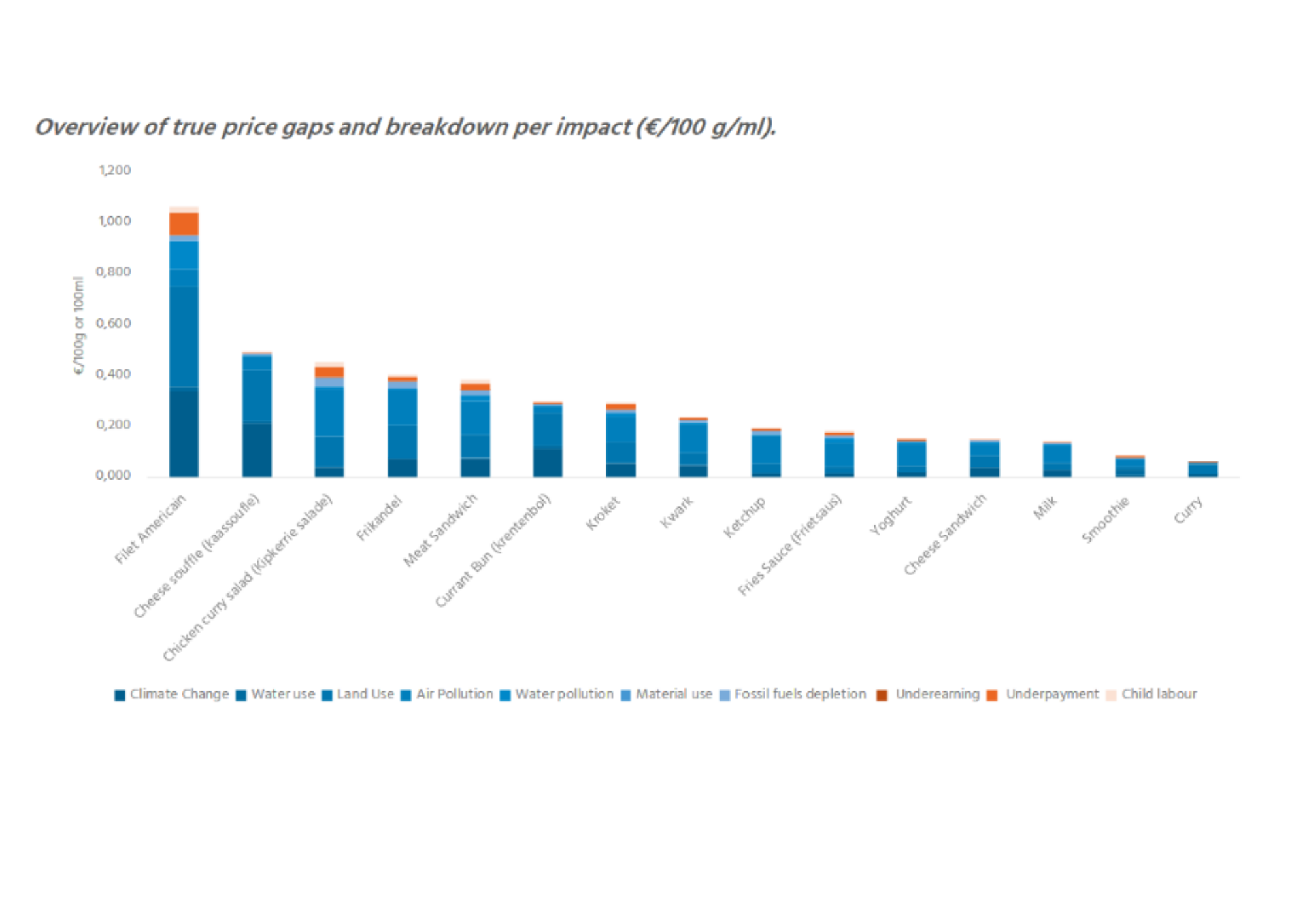
Some observations:
- The product with the highest real price gap is filet americain (~ €1 / 100 grams). This spread consists mainly of beef (~75%), which contributes substantially to climate change and land use. Beef accounts for 90% of the total impact of filet americain.
- The alternative (in terms of sandwich fillings), chicken curry salad, has a lower but still significant real price gap of ~ £0.46.
- A cheese soufflé has a lower price gap than other meat snacks such as a croquette (+ 67%) and frikandel (+24%). This is driven by the use of milk powder and whey powder in the cheese soufflé.
- Choosing a cheese sandwich over a meat sandwich has an impact. The latter has a real price gap (€0.38) that is more than double the real price gap of the former (€0.15).
- Zooming in on the dairy products in scope, the project found the lowest true price gap for milk (~ £0.14) compared to yoghurt (~ £0.15) and quark (~ £0.24).
Would you like more information about the method, definitions and more? Take a look at our publications, such as “Monetisation factors for true pricing” and “Valuation framework for true price assessments of agrifood products”, hier.
Good to know…
Review process
The assessment process in this project includes the process, scoping, modelling, data and reporting steps of a true price calculation, according to the True Price Assessment Method. One general validation round on the process and model was carried out by a team member not involved in the project.
All validation comments, questions and remarks were noted. They were processed by the project team. The processing was checked by the validators. All steps, choices and assumptions were discussed and approved by the partners.
Limitations of the results
This real price scan has some limitations related to the scope of data applications and availability.
- Scope of the value chain: we measure the impact in specific, material steps of the value chain for each ingredient. Some steps, which may have a limited impact on the real price, are not included. For example, transport to the restaurant, packaging and restaurant activities are not part of the scan.
- Focus on cultivation/production phase: most of the impact per ingredient was measured in the cultivation phase. For most ingredients, transport to and energy consumption in regional distribution centres were included as standard in the contribution to climate change.
- Impact of the ingredient in the processing phase: a limited part of the impact of ingredients was also measured in the processing phase. This was done because the secondary data included processing as standard (e.g. milk) or because this data was available. For example, when considering the impact of strawberry juice (process), energy consumption in the processing phase was included.
- Underpayment of farmers: with regard to the impact of underpayment, there is a lack of data from outside Europe. Therefore, underpayment for ingredients outside Europe has not been included.
- Data sources: In general, meta-analyses and larger datasets are preferred in order to optimise consistency, good data quality and mutual comparability. Due to the limited availability of data for products from some areas, different sources have been used for different products. As a result, complete comparability cannot be guaranteed.
- Not all data is the most recent data. As a result, it is possible that the most recent developments in agriculture have not been included in the results.