Remediation
What is the concept of remediation? Our vision of paying the true price is based on the concept of remediation, just like our accounting methodology. When we calculate the gap between the market price and the true price, we base it on the costs of remediating any social or environmental damage caused by producing a product. This is inspired by the 2011 UN Guiding Principles on Business and Human Rights (UNGPs), which state that businesses must respect human rights, and if they are violated, remediation should be provided. In this context, remediation means making things right, or as close to right as possible.
This is at the core of what we call our rights-based monetisation approach. It allows us to show human rights and labour rights violations—harms that should never have occurred—next to the environmental costs and the price of a product, thus making it possible to communicate in a language we all understand, that of prices.
True prices to fund remediation initiatives
As true prices show the remediation costs, this means that paying the true price for a product should not only cover the production costs but also a proportion of the cost of remediating the social and environmental damage it caused. This can be done by individuals and organisations alike, as the burden can be shared between businesses, investors, communities and individuals who can afford to do this. Paying the true price may seem like a small step—maybe an extra 20 or 30 cents on a purchase transaction, which doesn’t change much in the big scheme of things. But when it’s adopted at scale, it can direct large sums of money where they are most needed. It also shows that there is a movement of people and organisations who want real action for a fairer and more sustainable economy, and are ready to pick up a proportionate part of the bill.
Funds can be raised for addressing social and environmental costs linked to the production and consumption of products. This can take the form of restoration, prevention, or compensation for the harm done. Our upcoming Remediation Guidelines say that if a company or organization asks people to pay the true price and collects funds to fix problems, they must guarantee transparency regarding where the money goes, who decides how it is used, and what impact it has. The guidelines will describe what remediation initiatives can be funded by true price payments, as well as the key elements a remediation project should include.
Two approaches to Remediation: Direct and Indirect
In practice, we see that remediation can take two main directions:
- Direct remediation involves working with your own suppliers and their suppliers, to improve environmental and social circumstances. It is the most impactful way to set up remediation initiatives because it builds on commitment and collaboration in the value chain.
- Indirect remediation means supporting existing efforts by other organisations on these issues in the sourcing region. It is a type of remediation that can be set up most easily, when direct remediation is not immediately possible, but it should not be seen as a substitute for taking other forms of action to reduce social and environmental costs.
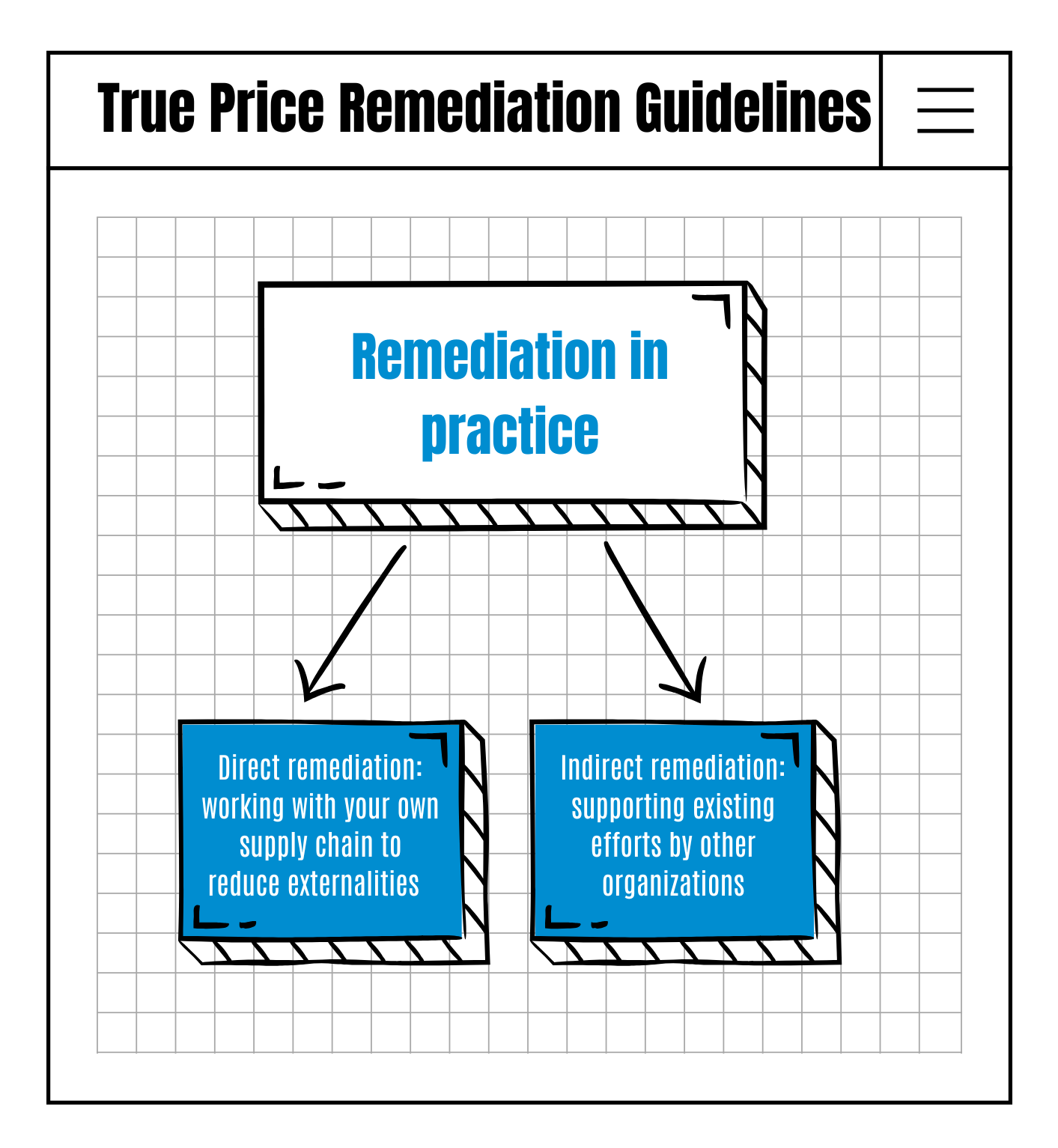
Both approaches can help tackle products’ hidden costs, and these distinctions are central to our Remediation Guidelines in True Pricing. We emphasize that restoration and prevention should be prioritized over compensation. This is in line with updated OECD Guidelines (2023) which say enterprises should prioritize eliminating or reducing sources of emissions over offsetting, compensation or neutralization measures.

Part of the solution
True price payments can empower large and small organisations, individuals and communities to act upon their duty to care about the social and environmental impacts of the products they buy and sell. This said, we also want to stress this is only one part of the solution. . The existing crises of inequality, biodiversity and climate change, require systemic action from companies, investors, governments, and communities. Businesses must focus on offering more sustainable products, improving environmental performance, and enhancing working conditions across their value chains. Investors should reward sustainable and inclusive practices, while policymakers need to facilitate the internalization of external costs through regulation and fiscal instruments.
While we work towards this transition, true price payments can be a powerful tool to create funds and support more sustainable and equitable economies.
If you would like to learn more about joining a remediation initiative or implementing true price payments in your business, we encourage you to reach out to us at pietro@trueprice.org or estefania@trueprice.org
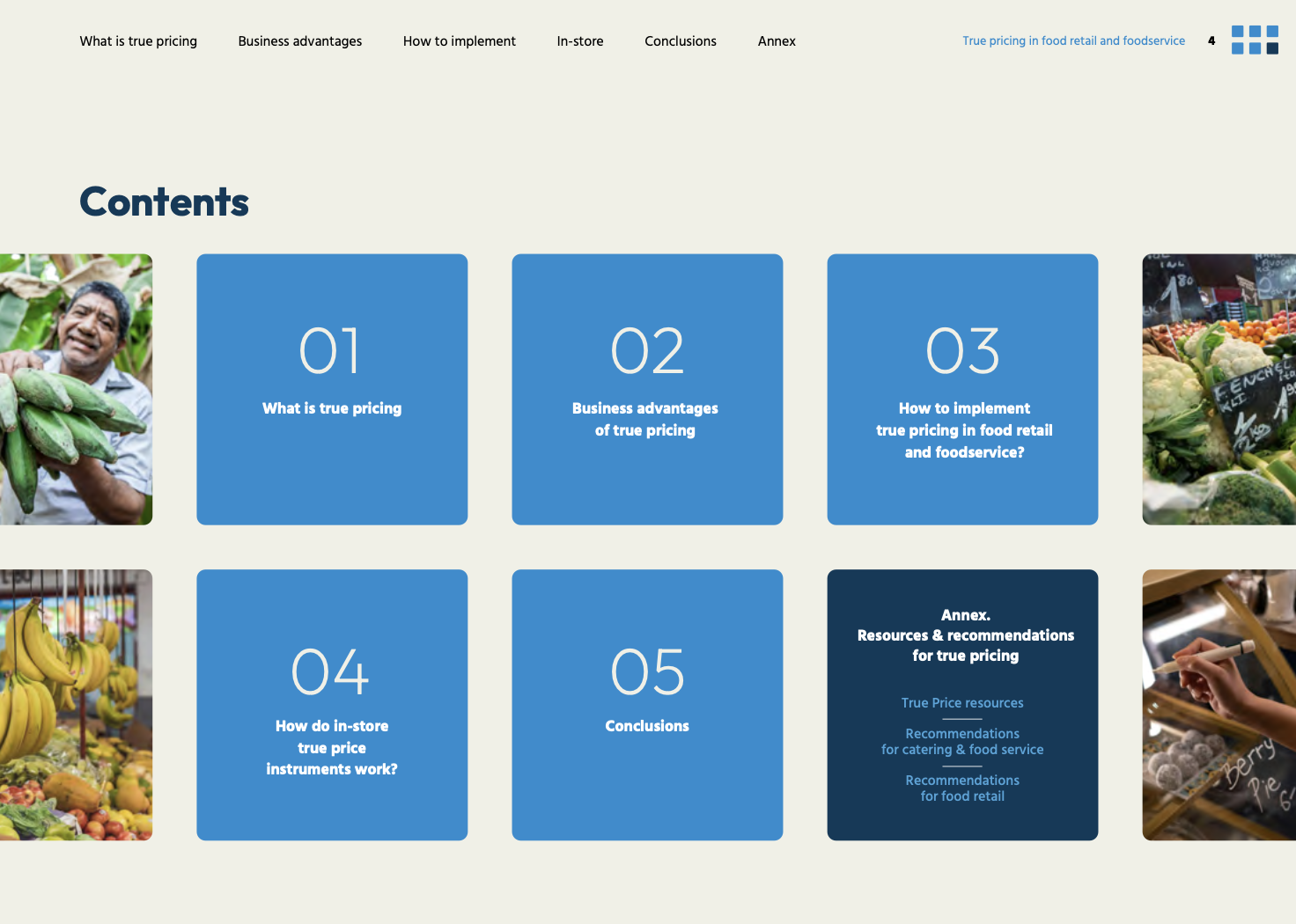
True Pricing in food retail and food service: a blueprint
Hidden costs on the menu, true price transactions, procurement, remediation…How can the food sector approach true pricing in the best way? How do all these elements fit together? And what are do’s and dont’s?
We are excited to share the release of, True Pricing in Food Retail and Food Service: a Blueprint. A guide to help food retailers, foodservice providers, and others in the food industry to understand and implement true pricing. As momentum for true pricing grows across the industry, and people wonder what true pricing looks like in practice, this publication equips organizations on their journey towards more transparent, sustainable practices, and aims to clarify some common misconceptions.
Highlights include:
- A clear introduction to the concept of true pricing and the business advantages of adopting it.
- Practical guidance on the types of true pricing strategies that food retail and food service businesses are adopting, from uncovering hidden costs to integrating true price payments.
- Lessons learnt from pilots in The Netherlands and Germany.
Whether you’re a supermarket, café, restaurant, or canteen, this resource will help you identify ways to engage customers and improve sustainability. Reach out to us if you have any questions or would like further support on how true pricing can benefit your business.
We thank the Chocolonely Foundation, Gieskes Strijbis Fonds and Stichting DOEN for supporting this work.
📩 Questions or want to learn more? Contact us at info@trueprice.org.